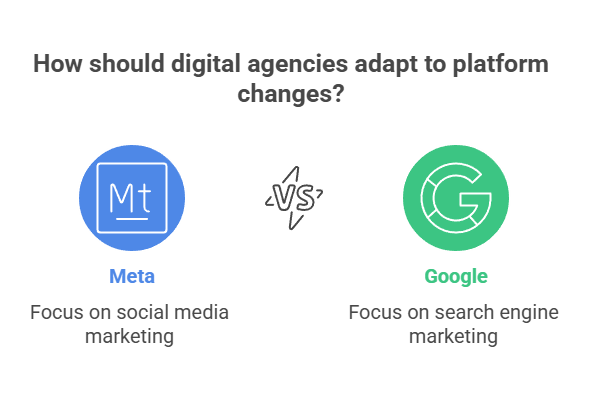
In the rapidly evolving ad-tech landscape, Meta & Google Update 2025-26
Agency Marketing & Sales departments must move faster than ever. With Meta and
Google is rolling out significant changes in November 2025; your internal handbook
and how your teams collaborate on strategy, targeting,measurement, and process
must incorporate these updates. This blog drills into the key platform changes at
Meta and Google explain their implications for agencies
and provide
actionable steps for your marketing & sales teams to stay ahead.
Section 1: Key Updates from Meta Platforms (Nov 2025)
1.1 Messenger Inbox Placement Removal
One of the most immediate changes: Meta will end delivery of the Messenger Inbox ad
placement on 11 November 2025. ([SocialBee])Agency implication: If your agency runs campaigns with manual placements that
include Messenger Inbox (or click-to-Messenger entry paths), you must audit and update
immediately. Leaving this placement active can lead to drop-off or wasted spend as delivery
shifts. (Marga Bagus | Digital Freelancer)
1.2 GA4 Cost-Data Import from Meta
Meta now supports the import of its cost data directly into Google Analytics 4 (GA4) via an
integration, simplifying spend tracking, budget reconciliation, and cross-platform
measurement. (Marga Bagus | Digital Freelancer)Agency implication: This means you and
your Marketing & Sales teams can now build spend-guards, blended cost-per-acquisition
(CPA) dashboards, and unified attribution models with less spreadsheet work. It also enables
faster, more reliable reporting to clients.
1.3 Threads Ads Verification & Format Upgrades
Meta’s newer placements, especially Threads, now include third-party verification (via
partners like DoubleVerify, IAS) for brand safety, and allow 4:5 aspect-ratio creatives plus
static carousel and video formats. (Marga Bagus | Digital Freelancer)Agency implication: If
your agency hasn’t yet tested Threads ads, this is a strong “early mover” opportunity. But you
must treat it like a test: allocate a modest budget, use 4:5 formats, track performance
carefully, and evaluate whether this newer placement justifies scale.
1.4 Brand Safety & Fraud Concerns
Leaked documents reveal Meta derived a significant portion of its 2024 revenue from ads
tied to fraud or banned goods, raising brand-safety risk. (Reuters)Agency implication: When
pitching to clients, emphasize your agency’s diligence in placement-audit, targeting-filtering,
and ROI oversight. This is a key trust factor for clients concerned about brand reputation and
ad-waste.
Section 2: Key Updates from Google LLC (Nov 2025)
2.1 Incrementality Testing Becomes More Accessible
Google announced on 11 November 2025 that it is making its incrementality testing tools
cheaper, faster, and more accessible, lowering minimum budget requirements from
historically large thresholds to as low as $5,000. (PPC Land)Agency implication: For your
agency’s Marketing & Sales teams, this opens up a powerful differentiator: you can offer
clients true measurement of what would not have happened otherwise (i.e., causal impact)
rather than just last-click attribution. This strengthens your value proposition, helps justify fees,
and optimizes campaign spend.
2.2 Google Ads = New Features & Brand Suitability Controls
On the same date, Google also expanded brand-suitability controls (for YouTube Feed &
Discover placements) and more transparent reporting for advertisers. (Google Help)Agency
implication: This strengthens your agency’s ability to ensure safe placements, protect clients’
brands, and demonstrate high transparency in performance reporting.
2.3 Search Algorithm Volatility & Reporting Changes
Search communities noted increasing ranking shifts around 12 November 2025, suggesting
That SEO/organic strategy must also stay alert. (Search Engine Roundtable)Agency
implication: For your integrated service offering (SEO + paid), you must prepare for potential
ripple-effects in search traffic, which can impact ad campaign timing, landing-page
optimisation and client reporting.
Section 3: What This Means for Your Agency’s Marketing & Sales Department
3.1 Aligning Goals & Metrics
Shared KPI: blended ROAS (return on ad spend) across Meta + Google platforms,
rather than siloed platform metrics.
Marketing must report not just leads, but incremental value — i.e., leads that would not
have converted without the campaign. Use Google’s incrementality tools.
Sales must feed back into marketing, which placements/formats produce quality leads
(e.g., Threads vs traditional placements).
3.2 Updating Processes & Workflow
Budget reallocation: With Meta’s removal of Messenger Inbox and Google’s cheaper
Incrementality testing, you must re-evaluate budget splits between placements and
platforms.
Lead-to-close workflow: Marketing runs new placements like Threads or GA4, cost-imported data; Sales receives better-qualified leads, tracks conversion, and loops in insights back.
Monthly review meeting: Marketing presents spend-guard dashboards, conversion
analysis, and incrementality experiment outputs from Google. Sales shares lead quality issues (e.g., Messenger Inbox removal impacted pipeline?).
3.3 Creative & Campaign Strategy
Both: emphasise creative freshness, audience re-segmentation, and measurement
clarity (not just click-metrics).
Meta: ensure ad sets no longer include Messenger Inbox; test Threads formats with
4:5 creative and static carousels.
Google: run incrementality experiments with clients to prove value, especially for
higher-spend campaigns.
3.4 Tools & Technology Stack
Ensure your CRM tracks lead source + placement + experiment status, enabling Sales
to feed back to Marketing seamlessly.
Ensure your agency’s tech stack supports: cost-data ingestion from Meta into GA4;
integration of Google Ads incrementality testing; cross-platform dashboards for
Marketing & Sales alignment.
Use reporting templates: Spend-Guard (for Meta GA4 cost import) and Incrementality
Summary (for Google).
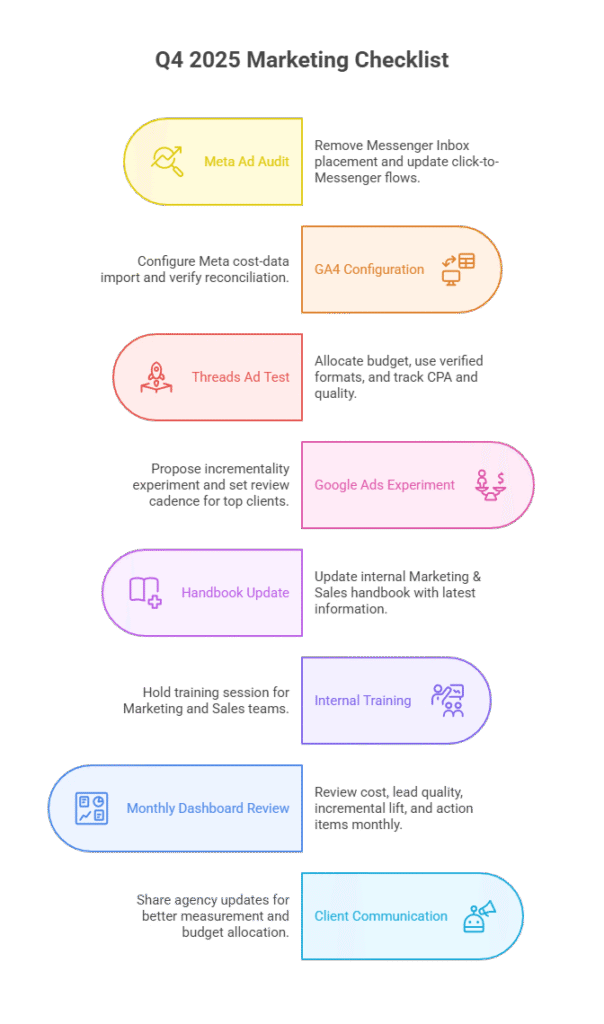
Section 4: Actionable Checklist for Q4 2025 & Beyond
- ✅ Audit all Meta ad sets: remove “Messenger Inbox” placement; update click-to-Messenger flows.
- ✅ Configure Meta cost-data import into GA4; verify cost, conversions, and ROAS
reconciliation. - ✅ Launch a Threads ad test: allocate 5-10% of social budget, use verified 4:5
formats, track CPA, and quality. - ✅ For top clients: propose a Google Ads incrementality experiment (budget ≥
$5k) and set cadence for review. - ✅ Update your internal Marketing & Sales handbook: include the latest placements,
measurement tools, and process flows described above. - ✅ Hold an internal training session so Marketing and Sales teams understand the
new tools (Meta’s new placements + Google’s incrementality) and how to collaborate
on insights. - ✅ Set a monthly dashboard review: cost by platform, lead quality by placement,
incremental lift experiments, and action items. - ✅ Communicate to clients: share how your agency is leveraging these updates for
better measurement, fewer wasted impression,s and improved budget allocation.
Conclusion
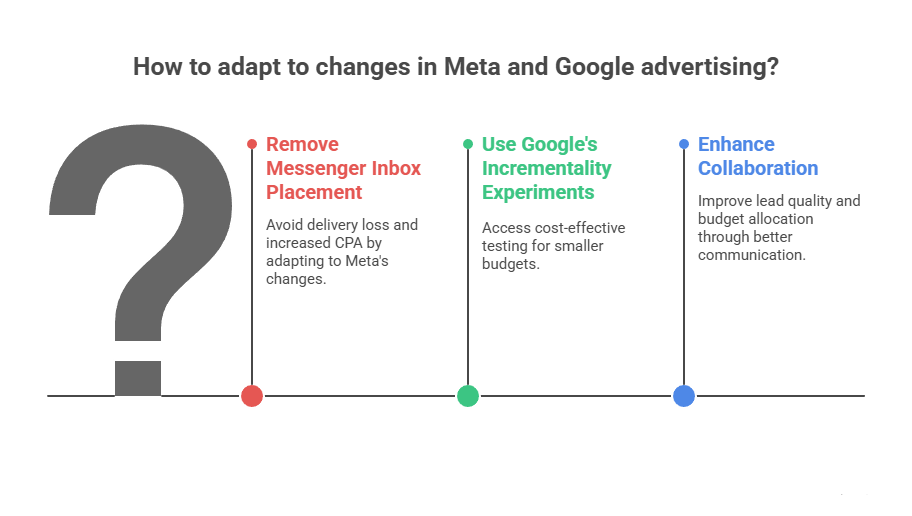
For digital-marketing agencies, staying ahead of platform updates is not optional — it’s
essential. Meta’s November 2025 changes (placement removal, improved measurement,
new formats) and Google’s push for more accessible incrementality testing represent major
shifts in how campaigns must be planned, executed and measured. By updating your
internal handbook, aligning Marketing & Sales teams around new metrics, and adopting the
right tools and workflows, your agency will be positioned not only to survive but to thrive in
this newer ad-ecosystem. The early-mover agencies who integrate these changes now will
win both client trust and measurable results.
Leave a Reply